


Easy Ways to Increase Learner Engagement

December 5, 2023
Article titled

To teach in an engaging and inspiring manner, transform content into an experience that maximizes impact.


What it is


Engagement tools such as cards, posters, discussion guides, workbooks, and stories can enhance the learner experience. Although creating interactive materials will extend the program-development timeline, the trade-offs are well worth the payoff.


How it works


Breaking the classroom into smaller groups and leveraging those tools fundamentally makes learning more engaging and memorable.


Remember that people are more likely to engage in small groups (up to six people) than large ones. When individuals work in small groups, their participation becomes more meaningful and individually relevant to the activity or conversation.


In a virtual environment, the inclination to engage is even more obvious as the group size decreases. Large virtual groups tend to cause participants to feel isolated and anonymous. Conversely, the willingness to turn on cameras or stay unmuted dramatically increases in partner and triad situations. Those behaviors drop the veil of anonymity and improve social connection.


Small-group activities offer additional benefits beyond social pressure and psychological safety. In an in-person setting, the mere act of joining a group requires physical movement. That affects a participant’s heart rate and increases focus.


A group of people who work through an activity together for just 10 minutes will bond dramatically more than a group of 50 people who sit in a room listening to a lecture for an hour. Relationships make the learning process stickier and more fulfilling.


Guidelines


With a macrolevel understanding that learners are naturally more engaged in smaller groups, the next challenge is determining what methods will achieve a workshop’s desired outcomes. We regularly lean on the following tools to structure and activate learning, particularly in small groups.

Read the article for more information about the tools we use. Subscription  or purchase required.

Share this article

Recent Posts

Nine illustrated video call participants in colorful tiles with reaction icons along the bottom
By Kara Davidson • November 2, 2026
On video, if you’re not talking, you may just disappear. How to build virtual presence that’s still you, with real examples from our coaching.
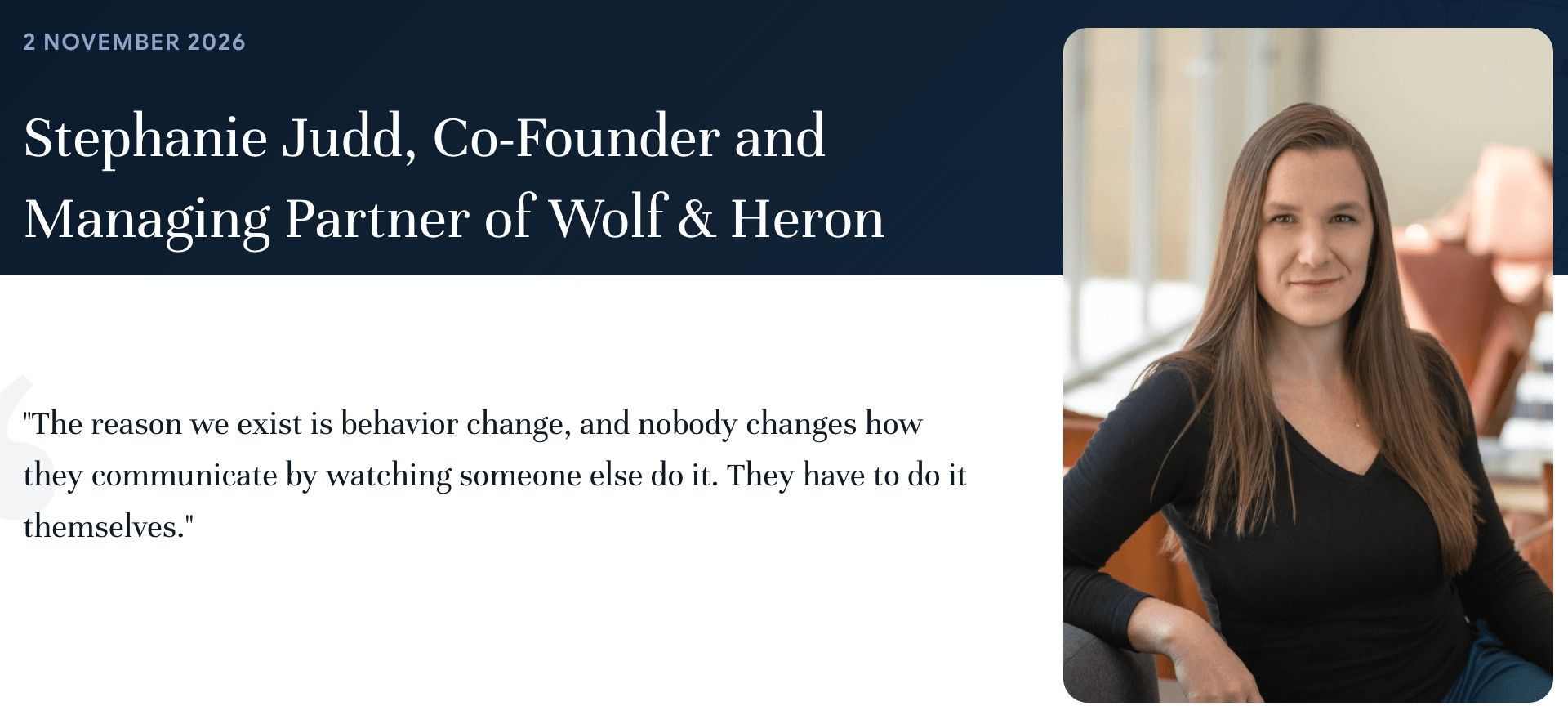
Stephanie Judd interview in The Executive Insight
November 2, 2026
Wolf & Heron co-founder Stephanie Judd talks with The Executive Insight about slide-free training, surviving COVID, and closing the gap between agreement and action.

By Stephanie Judd • October 19, 2026
The first time Stephanie watched Damien work, he had a Palm Pilot in each hand, an earbud in each ear, and apparently half his brain listening to two calls simultaneously. (Yes, that Palm Pilot reference ages Stephanie. She’s aware.) Damien seemed to be everywhere at once, always with something to give. He was also her skip-level boss. His kids were teenagers, and Stephanie was closer in age to them than she was to him. In her first job out of college, he both impressed and terrified her.  So when Stephanie was sent to Ithaca, NY on a recruiting trip to Cornell with Damien, her nerves took over. She saw this two-day trip as an amazing opportunity to build a relationship with him, and she wanted to make sure to impress him with her easy competence and magnanimity. Yes, always the overachiever, Stephanie had a clear vision of how the trip was supposed to go.

By Kara Davidson • October 5, 2026
It's never been more important to be yourself. Kara's brother learned this while hiring for his company. He was eight interviews into a search for a new position at this company, and every one of them wasn’t who they said they were on their resume. Some invented their experience. Others leaned so hard on AI that he couldn't find the actual person behind the answers. He was aggravated trying to figure out what was real and what wasn’t. All he knew for sure was that he couldn’t trust his own read, so he handed the search to a recruiter. That's what happens when people can't tell what's real. They get suspicious of everyone. And when one thing about someone seems off, we doubt the whole person: the experience, the credentials, the firm handshake.
Show More